Friday, June 6, 2014

Driving Range Renovation

In the last couple months at Minor Park, we completed the renovation of our Driving Range to help improve the look of the tee. Come out and enjoy the new tee line!

 Below are some pictures of what was completed:


After stripping off small amount of existing grass


New walkway form


New paver walkway form behind tee


Installation of pavers from old tee complexes
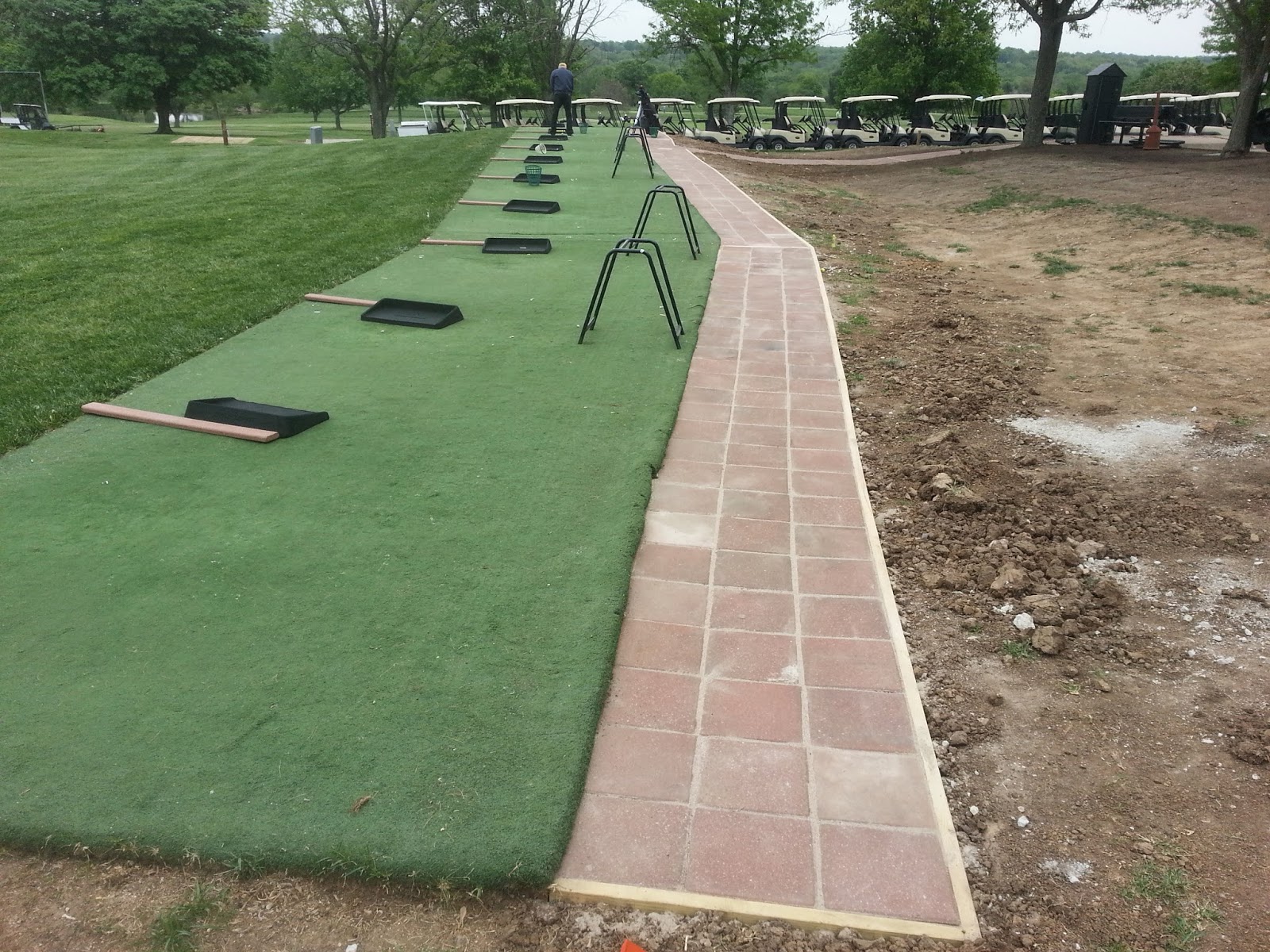


Finished Product


600 yards of tall fescue being installed


Final completion of turf and red paver walkway


Old synthetic turf removed


Finished project with new synthetic turf, tall fescue and red paver walkway
 

Friday, April 11, 2014

Aerification Time!


This year we top-dressed first then aerified.


Finished Product


We have completed our spring aerification on Monday! Greens are playing very well 4 days from completion. we were able to roll 3 times and mowed for the first time today. This bi-annual practice helps ‘open up’ the putting surfaces so we can ensure a healthy root system by reducing the compaction brought on by heavy foot traffic and daily mowing. Here’s more…

Sometimes it’s good to vent

Presented by the Golf Course Superintendents Association of America
It’s a perfect, sunny morning and you’ve just reached the first green in regulation. You feel great and you know you’re within birdie range. Then, you see them, those little holes in the green. Arrggh! They’ve just aerified the course, and it’s going to ruin your round, right?

Well, maybe not. Consider the fact that PGA TOUR legend Tom Watson shot a sizzling record 58 at his then-home course, Kansas City Country Club, just days after the greens had been aerified.

Consider also that aerification is merely a short-term disruption that has long-term benefits for the course. When you see them, remember that without those little holes, the greens would eventually die.

Preventative maintenance is an integral part of successful golf course management. Golfers view aerification as an inconvenience that takes the greens out of play for a day, pulling cores from the greens and leaving holes that can affect putting for many days before healing. To add insult to injury, aerification is best done in many parts of the country during mid-summer, at the height of the playing season and when most greens are in prime condition.

But a golfer needs to understand how important aerification is to producing healthy turf.

Aerification achieves three important objectives. It relieves soil compaction, it provides a method to improve the soil mixture around the highest part of a green’s roots and it reduces or prevents the accumulation of excess thatch.

Like so many things, the quality of a good putting green is more than skin deep. In fact, the condition of a green has a lot to do with what goes on below the surface. In order for grass to grow at 3/16-inch, it must have deep, healthy roots. Good roots demand oxygen. In good soil, they get the oxygen from tiny pockets of air trapped between soil and sand particles.

Over time, the traffic from golfers’ feet (as well as mowing equipment) tends to compact the soil under the putting green – particularly when the soil contains a lot of clay. When soil becomes compacted, the air pockets on which the roots depend are crushed, and the roots are essentially left gasping for air. Without oxygen, the grass plants become weaker and will eventually wither and die.

Aerification is a mechanical process that creates more air space in the soil and promotes deeper rooting, thus helping the grass plants stay healthy. In most cases, it’s done by removing ½-inch cores (those plugs you sometimes see near a green or in fairways) from the compacted soil, allowing for an infusion of air and water that brings a resurgence of growth. The spaces are then filled with sand “topdressing” that helps the soil retain air space and makes it easier for roots to grow downward.

Older greens often are constructed of soils with significant amounts of silt, clay and fine organic particles that are prone to compaction. Filling aerification holes with sand improves drainage and resists compaction. The periodic introduction of sand to a green’s top layer can over time, avoid or postpone expensive rebuilding or renovation of greens.

Finally, growing of turf adds to a layer of organic matter on the surface. This layer, called thatch, is an accumulation of dead stems, leaves and roots. A little organic matters makes for a resilient green, but too much invites diseases and insects. Topdressing with sand can prevent thatch buildup, and aerification is one of the best ways to reduce an existing layer and prevent an excess of thatch from becoming established.

Other aerification techniques use machines with “tines” or knives that simply poke holes through the soil profile. A new technique even uses ultra high-pressure water that’s injected through the soil profile to create small holes that relieve some compaction but heal quickly.
There are many types of aerifying machines with different attachments that address different problems in the various stages of the life of a green. So the next time you’re ready to scream when the aerifiers are brought on the course, remember that a little preventative maintenance produces the best greens over the long haul.

The bottom line is that aerification is a necessary practice. But before you curse the superintendent for ruining your day, just think of Tom Watson.

For more information regarding golf course management practices, contact your local superintendent or the GCSAA at 800-472-7878 or
www.gcsaa.org.
Sources: USGA’s Green Section

Sunday, February 16, 2014

Monday, October 28, 2013

Frost Delays

Well once again its that time of the year where you start having the dreaded frost delays. As I sit here writing this we just had a hour and a half delay to start golf. I understand that it can be frustrating for golfers so I would like to share some information from the USGA.

I am an early-morning golfer. What is the justification for frost delays?

 Frost Issues
Frost is essentially frozen dew. Ice crystals visible on the outside of the plant can also form on the inside of grass blades. The grass plant, normally resilient to footsteps or cart traffic, becomes brittle and fragile when ice crystals form. Under the pressure of traffic, ice crystals puncture living plant tissues and rupture plant cells. Damage will not appear right away, but it will show up in footsteps and tire tracks the following days as the plant is unable to repair itself and begins to die. Frost damage can occur on any turfgrass mowed at any height, but it is amplified when the plant is mowed low, as on a putting green.
Keep in mind that a foursome typically takes several hundred footsteps on each green, so even allowing just a few groups to play when frost is present can be very damaging to the greens, as well as to the rest of the golf course. It is not completely understood when frost will cause damage, so the decision to keep traffic off the course must be made conservatively to protect the condition of the course. For this reason, golf facilities are wise to delay starting times in the morning until frost has completely melted.

Here is the Definition on frost and what causes it:

Frost is the solid deposition of water vapor from humid air. It is formed when the temperature of a solid surface is below the freezing point of water and also below the frost point.


Frost Damage on Putting Green.
 
 
Hopefully this gives some good information on why we have frost delays. Course is in great shape and soon we will be going to Cart Path Only!!!!! So if you can get away from work please come out to Minor Park Golf Course.


Friday, October 4, 2013

Aerification Completion

Its been over a week and a half since aerification was completed. Greens are recovering nicely and the holes are almost completely covered.  This year we tried a new piece of equipment for Minor Park Golf Course, The Core Collector. This equipment attaches to the back of the procore 648 and collects all the cores that are brought to the surface and then deposits them on the edge of the green for collection. By having this attachment we were able to eliminate the use of the core harvester and help save traffic placed on the green. Below is a picture of this new attachment.


Greens 1.5 weeks after Aerification
 
As the season comes to an end I would like to thank my hard working staff for the work they put into Minor Park Golf Couse. With my second season under my belt I hope that anyone that comes and plays can see the hard work and dedication that myself and my staff have at Minor Park. 


Thursday, September 19, 2013

Aerification and Seeding

Just a reminder that we will begin aerification on Sunday September 22nd at 4:00 Pm. We will be closed Monday September 23rd and if everything goes smooth we will have 9 holes open on Tuesday September 24th. Thank you for your pateinces during this process.

We are currently in the process of seeding areas on the course. We were able to seed the area where the bunker was on #10 green right before the first rain this week. We are out doing cool season tees tops that will be used for winter play and after areification we will begin seeding rough areas around green banks and tee banks.


Thursday, August 29, 2013

Kansas City Star

On Monday August 26th, we had a photographer from the Kansas City Star come out and take some photos of my staff out hand watering. With the temperatures soaring into the mid to upper 90's we had to continue our regiment of hand watering spots on greens.  A typical 90 degree day starts with watering spots on greens and collars, then at 12:30 we begin 2-3 runs of light watering on the putting surface This process typically keeps us on the greens for less than 5 minutes and we move to the next. Afternoons with high humidity and high temperatures we don't want to have excessive water placed on the green so our light syringing allows us to wet the surface and drop the canopy temperatures.

Here is the photograph that made the Kansas City Star:


From the latest weather report it looks like we will receive a break from this heat wave after Labor Day. The overall course conditions are great, so if you have time please come out and enjoy a round at Minor Park Golf Course.


Here is a video from the USGA on hand watering:

New #7 Bridge

 About two months ago, an accident occurred off of 115th street on the south end of the golf course. The vehicle came through the fence and ...